
Free Will Isn't Dead - It's Just Misunderstood
What neuroscience, computational minds, and Buddhist monks reveal about your freedom to choose.

In this "Theories of Everything" podcast, the late (great) Daniel Dennett criticised philosophers for overemphasising the definition of terms, creating a state of 'analysis paralysis' that hinders philosophical progress. He argues that striving for precise definitions is often futile. Taking biology as an example, Dennett notes that biologists don't obsess over defining 'life' to the minutest detail. They acknowledge a continuum, but crack on with scientific progress nonetheless. They recognise that while a cat is clearly alive and a rock is not, there are grey areas like viruses or ribosomes where the boundary of ‘life-ness’ is blurry. Despite this they proceed based on practical definitions based on the cell to study life's behaviour.
The pursuit of precise definitions for objects and concepts is somewhat in vain, as they don't exist in base reality as we perceive them. They are merely mental constructs used to make sense of the world. Consider water: while it appears as a liquid, it's fundamentally a construct of hydrogen and oxygen atoms, themselves models or constructs to represent the effects of interactions between different types of information units. Delving deeper into the underlying substrate of our universe reveals no inherent properties except in their interactions. E=mc² blurs the lines between matter and energy, revealing them to be essentially the same. Our perception of reality is a simplified, coarse-grained interpretation of complex, interrelating information, rather than direct access to reality itself.
However, in philosophical debate, clarity in defining terms is absolutely crucial for effective communication and understanding in the search of truth. We don't necessarily need the exactness of mathematics to progress debate and understanding, but clear articulation is key to avoid talking at cross purposes. This ensures our ideas are conveyed and grasped in their true essence, fostering meaningful dialogue.
The nature of Free Will has been an active and raging debate for thousands of years – is it real, is it illusionary, and what are the repercussions on moral responsibility, the justice system, and the extent to which we have true agency in our lives?
It’s a complicated topic made even more complicated because of the ease with which speakers on the topic bend and tweak their definition of free will.
For the purposes of this post, I want to start with a straightforward definition to set the stage. Wikipedia's definition of free will as 'the power of acting without the constraints of necessity or fate; the ability to act at one's own discretion' is straightforward and intuitive. It's a solid starting point to explore if determinism puts the concept of free will in a tight spot.
I hope by the end of this post to not only convince you of the existence of free will, as defined within a deterministic framework.
The Evidence For Determinism – It’s Mechanistic Laws all the way down
The trajectory of science points towards a deterministic view of consciousness. Neuron activity in our brains, which drives our sense of being alive, strictly adheres to the laws of physics. These neurons, acting mechanistically in response to stimuli in their environment, don't possess awareness of their part in our larger consciousness. Our conscious experience, our 'spirit,' is the result of these self-organising neurons, governed by physical laws, not by any ethereal force.
Critics of determinism often bring up quantum mechanics as a counterargument, suggesting that it introduces randomness into our conscious experiences. However, this doesn't provide a strong counterpoint for two reasons. Firstly, randomness introduced by quantum mechanics does not equate to increased personal agency. Secondly, there's little to no evidence that quantum mechanics plays a role at the scale of brain neurons — its effects are more pronounced at far smaller scales.
For many philosophers and scientists examining this topic, determinism is a largely resolved debate. They argue that all our actions and behaviours are the outcomes of mechanical processes, determined by our genes and life experiences.
This leads to a key question in the debate on free will: How can we claim to act at our own discretion if our decisions are the product of mechanical processes?
Is Free Will an Illusion?
In Sam Harris's perspective, determinism renders free will a mere illusion, calling for a fundamental re-evaluation of our concepts of moral responsibility. Harris illustrates this through a harrowing real-life narrative of two habitual criminals who commit atrocities against a family during a robbery. He highlights the backstory of one offender who, having suffered repeated child abuse, expressed astonishment at his own brutal actions during the crime. Initially intending only theft, he found his reactions escalating uncontrollably in response to the unfolding events.
Harris presents a thought experiment: if he had the identical genetic brain composition and life experiences as the criminal, he would, down to every atom, have perpetrated the same crimes. He argues that these criminal behaviours can be traced back to a combination of genetic predisposition and life experiences, both factors beyond an individual's control. This raises the question: can we truly hold individuals accountable for actions determined by their genetic makeup and environmental circumstances? Isn’t Free Will really just an illusion?
Extending this argument, Harris observes that our moral judgments shift when we learn of mitigating circumstances behind someone's actions. He notes that discovering a brain tumour as the cause of violent behaviour significantly alters our moral stance, suggesting that neurological conditions are merely specific instances of physical causes leading to certain thoughts and actions. This leads to a deeper question: in understanding the neurophysiology of the brain, which seems to absolve responsibility just as much as a physical tumour, how do we then make sense of our lives and hold individuals accountable for choices that originate from the unconscious depths of our minds?
Our Subjective Experience Exposes Deterministic Qualities
Sam Harris's insights are notably shaped by his meditation practices, which reveal the limits of our personal agency. Meditation uncovers a profound truth: thoughts do not originate from our deliberate, attentive self. Instead, they emerge into our consciousness from the subconscious. This suggests that the mechanistic operations of our subconscious largely govern our conscious experiences. Thoughts are presented to us, and we often fall under the illusion that we are the authors of these thoughts. In everyday activities like writing a blog post or engaging in a conversation, it's common to realise that the words we express or type come to us spontaneously, without premeditation, and we only become conscious about them after the fact.
However, this leads to a compelling paradox. If Harris is correct, and our actions are mechanistically driven, devoid of moral responsibility and choice, then are we merely passive observers of our lives, akin to puppets manipulated by the strings of our subconscious? Are we mere spectators, idly watching the unfolding of our lives on a screen?
The Role of Consciousness
But there's a deeper layer to consider. Why do we have consciousness if it serves merely as a passive observer? Evolution is skilled at developing efficient systems, often relegating repetitive behaviours to the unconscious to conserve energy. This is evident in skills like driving or playing an instrument, which become second nature over time as we go into autopilot. Similarly, habits form because they reduce the cognitive load of repeated novel decisions.
Yet, the persistent reality of conscious awareness suggests it must have a functional utility for the brain. Consciousness appears essential for animals, including humans, who must navigate complex environments, learn, make decisions, and react in uncertain situations. If the conscious part of ourselves, which we consider to be the core of our being, were merely observing the actions dictated by our subconscious, it would seem redundant.
I propose that conscious awareness serves a critical function: it enables us to both learn and make decisions that support our well-being and survival. Consciousness is not just a passive observer; it is an active participant, aiding in decision-making and enabling us to adapt to changing circumstances and environments.
Reframing the Debate: The Opposite of Free Will is not Determinism, it’s Compulsion
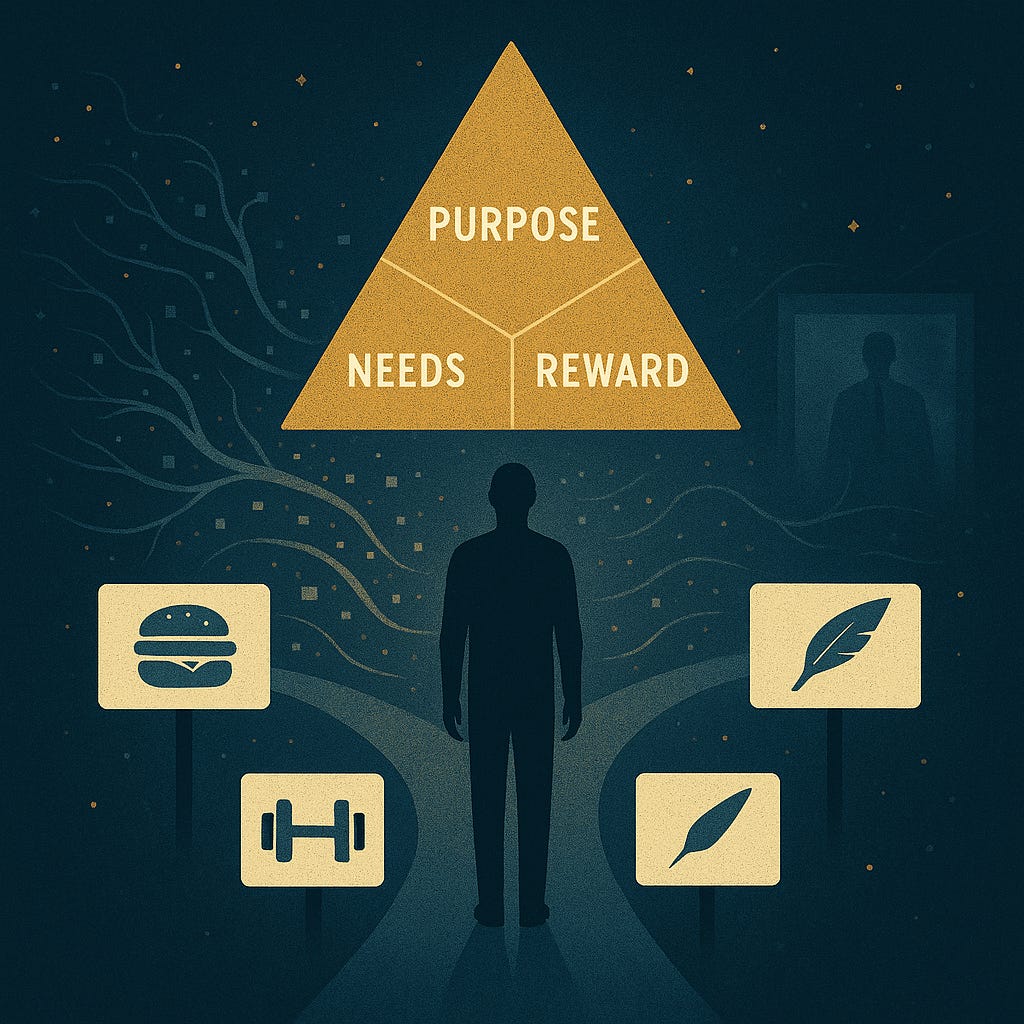
I think the paradox can start to be resolved if we re-evaluate the nature of consciousness through a computational lens applied to brain function. In this paper, Joscha Bach approaches the mind using a computational framework. He argues that the mind's learning and decision-making processes can be likened to algorithms driven by reward maximization. These rewards are tethered to needs that yield positive reinforcement (manifested as pleasure) when met and trigger pain signals when unmet.
These needs span a wide range: physiological (such as nutrition, rest, physical integrity), cognitive (like competence, exploration, aesthetics), and social (including affiliation, dominance, nurturing, legitimacy), among others. However, it's crucial to note that our behaviour is primarily motivated by anticipated rewards, essentially models of these needs. These models, or purposes, are well encapsulated in Maslow's hierarchy. Unlike straightforward needs, which elicit direct pleasure or pain responses, purposes establish hierarchies to reconcile conflicting desires (for instance, the craving for a burger versus the aspiration to maintain a healthy weight). Every individual possesses a unique internal hierarchy of purposes. When our decisions align with these purposes, we are exercising free will.
Bach suggests that free will is the capacity to serve one's purposes. Hence, its antithesis isn't determinism or coercion, but compulsion, which he defines as the disruption of purposeful behaviour by actions that serve immediate needs rather than the agent's overarching purposes.
Consider the start of a typical day: we may set intentions like eating healthily, going to the gym, calling friends, or working on a blog post. Yet, as the day progresses, we often find ourselves not fulfilling some or (on a particularly lazy day) none of these goals. The unplanned indulgence in a Chocolate Mousse from Pret, despite the initial plan to eat healthily, or skipping the gym after work, demonstrates this. These moments are instances where an impulse overrides our rational choice. Compulsion is the real enemy of free will.
What it feels like to act with Free Will
In Bach's framework, the sensation of exercising free will is when we make a decision that allies with our purposes in a scenario where the decision isn’t straightforward (for example, we don’t usually consider ourselves as using our free will when we do a mundane task like brushing our teeth). So, it usually arises when we face decisions in novel situations. These moments are characterised by choices that, though not immediately apparent, align with our deeper purposes and values. This experience becomes particularly evident when making significant life decisions, such as choosing a career path after university.
For instance, a graduate faced with this decision navigates through uncertainty, diverging from the predictable path of academic life. Here, they must consider various factors such as personal passions, market trends, and long-term ambitions. When the graduate chooses a career that resonates with their individual values and aspirations, even if it deviates from their academic specialisation, they are demonstrating free will. This choice, though complex and perhaps unconventional, aligns with their innermost goals, epitomising the exercise of free will as per Bach's perspective.
Conversely, if the graduate's decision is heavily swayed by external factors like family expectations, rather than their own aspirations, it can be argued that their free will is compromised. Suppose the graduate is inclined towards a career in creative arts but opts for a legal profession due to familial pressure. In this case, the choice reflects external influences more than personal desires, indicating a diminished exercise of free will. This contrast highlights how the alignment of decisions with personal purposes and values is central to the notion of exercising free will in Bach's framework.
Resolving the Paradox
In this framework, our decisions are still influenced by predetermined mechanistic processes shaped by genetics and environment.
For instance, a person's upbringing, like being raised in a family that emphasises academic achievement, or their social circles, like interacting with ambitious peers, can shape their attitudes and values. Similarly, genetic predispositions play a role in determining personality traits, such as extroversion or introversion, and can influence natural talents or emotional tendencies.
These genetic and environmental factors converge to form the subconscious basis for our hierarchy of purposes.
Applying this to the criminals in Harris's example, their upbringing in an environment lacking respect for the rule of law could have deeply influenced their decisions. Raised in a setting where legal norms are disregarded, they might internalise a worldview where criminal behaviour is seen as an acceptable strategy. This background shapes their purposes and therefore decisions, which, although appearing as free will, are heavily influenced by their early life experiences. Such choices, rooted in ingrained beliefs and values, demonstrate the interplay of environmental conditioning and genetic predispositions in shaping what we perceive as free will.
Exploring the Compatibility of Free Will and Determinism
In re-examining the definition of free will as 'the power to act without necessity or fate's constraints, exercising one's discretion,' a nuanced view emerges, particularly when aligned with Joscha Bach's concept of agency in decision-making reflective of our purposes. This perspective underscores free will as the ability to perform actions that resonate with our individual goals and aspirations. Yet, this definition of free will operates within the boundaries set by determinism, which subtly influences our conscious lives through the purposes we find ourselves inherently possessing – purposes that we didn't choose for ourselves.
The role of consciousness in this dynamic is crucial. Free will, far from being an illusion, is a tangible phenomenon that empowers individuals to make choices in line with their purposes. Our conscious awareness plays a key role in guiding our decision-making to advance our goals. However, this concept of free will is not in opposition to determinism. Rather, it coexists with it, acknowledging that while we have the freedom to make choices, the range of these choices is influenced by purposes that are often predetermined.
Schopenhauer's insight, "Man can do what he wants, but he cannot want what he wants," reflects the interplay between free will and determinism. This suggests that while we have significant freedom to shape our actions, our deeper purposes – the 'wants' behind our 'wants' – may be less malleable, embedded within us by the deterministic nature of the universe. Nonetheless, I propose that our capacity to refine and evolve these purposes, though perhaps not to completely redefine them, exists within our conscious power. This evolution, achieved through accumulating wisdom and maximizing the learning, thinking, and decision-making capabilities of our consciousness, will be explored in greater depth, at the end of the post. This approach allows us to harmonise our innate purposes with our conscious choices, navigating the balance between free will and determinism.
Determinism and Moral Responsibility
Sam Harris argues that we need to re-evaluate moral responsibility in light of determinism. However, what Sam misses is that an individual's identity, or 'spirit,' is intricately woven and cannot be separate from their purposes and behaviours. A person's 'self' is not isolated from the tapestry of their actions, decisions, and underlying purposes – thought patterns and decisions form what the ‘self’ actually is.
While our purposes may be influenced by mechanistic activity, this does not invalidate the practical and useful applications of free will. Individuals, whether born with certain neurological traits or influenced by their upbringing, are responsible for their actions if these actions align with harmful purposes. There is no separate 'soul' or 'spirit' in a person beyond their purposes, needs, and personality. To assert that someone is not morally responsible for actions that align with their purposes and intentions is akin to arguing that an architect is not responsible for the design of a building that they have meticulously planned and constructed. The building, a product of the architect’s vision, skills, and decisions, is a direct manifestation of their professional identity.
Revisiting Sam Harris’s brain aneurysm analogy, he argues that if a brain aneurysm, which can drastically change behaviour, impacts our view of someone's moral responsibility, then a challenging upbringing should be viewed similarly. But there's a key difference here. A brain aneurysm can suddenly change a person's behaviour, marking a stark deviation from their usual self. In contrast, the influence of upbringing on character develops a consistent identity – they are that person.
Moral responsibility is about recognising that an individual’s free will actions are expressions of their true self, and their true self is just a manifestation of their thoughts, intentions and purposes.
A Point on the Justice System & Forgiveness In Light of Determinism
In grappling with the justice system and our response to others, we must acknowledge the implication of determinism though. It's essential to hold individuals accountable for antisocial actions for practical purposes, yet this understanding also implies we should approach judgment with calm rationality rather than anger or resentment.
Punishment in the context of determinism should serve dual purposes: the hope of realigning the individual's trajectory and purposes so they are more aligned and compatible with societal values, and the necessity of protecting the community from further harm. If we are to truly grasp the significance of determinism though, vengeance should play no part. There is profound wisdom in Jesus’s quote, “Forgive them, for they have not known what they do.”
This isn’t about excusing wrongful acts, but about recognising the deeper currents that shape human behaviour and realising the folly of being angry at people’s behaviour. Everyone, in their essence, is a part of the vast, unfolding universe, governed by the same physical laws that orchestrate the dance of stars and galaxies. People with harmful intentions are not external aberrations but are woven into the same cosmic fabric. Their choices, though appearing as free and independent, are influenced by a constellation of factors that extend beyond their immediate control, and the fundamental laws that drive their behaviours and actions, drive yours too.
Harmonising and Navigating Our Fundamental Purposes
Schopenhauer's quote, "Man can do what he wants, but he cannot want what he wants," underscores a significant limitation on our freedom set by determinism: we are not free to define our core fundamental purposes. These intrinsic purposes, often established outside our conscious choice, delineate the boundaries of our free will. However, the struggle many people face is not necessarily due to the purposes themselves, but from a lack of clear identification of these core purposes, leading to misalignment and suffering in their lives.
People often encounter unhappiness when they either fail to live according to their desired hierarchy of purposes or when their strategies for achieving some purposes inadvertently harm other purposes, creating contradictions. If these issues are not addressed, they can lead to chronic unhappiness and eventually depression. For instance, an individual in a demanding corporate role might be achieving professional success, a high-ranking purpose in their hierarchy. However, if this success comes at the expense of personal well-being or family time, it creates a contradiction that can lead to stress and dissatisfaction. By examining the core essence of their purposes, they might discover that the pursuit of professional success is fundamentally driven by a need for security or recognition, which could be achieved through less demanding means that also allow for family time and personal well-being.
Similarly, someone in a social environment that heavily values material success might initially conform to these standards. Over time, however, they might experience a sense of emptiness or disconnection, signalling a subconscious disconnect. By introspectively examining their purposes, they could realise that their pursuit of material success is actually a strategy to fulfil deeper needs for social belonging or self-esteem. Understanding this can lead them to seek fulfilment through more authentic connections and relationships, aligning their conscious actions with their subconscious drivers.
Addressing these internal conflicts involves harmonising our subconscious and conscious minds through a process of listening to our inner emotions and using this understanding to inform our conscious choices. This approach ensures that our actions and goals align not only with external influences but also with our personal values and aspirations, leading to a life that is fulfilling and consistent with our individual priorities. By doing so, we exercise our free will in a way that respects the constraints set by our fundamental purposes while creatively exploring various avenues to fulfil them harmoniously.
Mastering the Mind: Navigating Consciousness and Expanding Free Will
In discussing free will, I didn’t want to finish the post without discussing Keegan's adult development model, an extension of Piaget's work on child development. Robert Keegan, a notable Harvard psychologist, developed this model to illustrate the evolution of adult thinking and understanding. Central to this model is the subject/object perspective, a concept pivotal to understanding how we gain mastery over our thoughts and perceptions.
The subject/object perspective differentiates between what we are subjectively immersed in ('subject') and what we can objectively reflect upon and control ('object'). When an aspect of our psyche is 'subject,' it is a part of us that we can't easily see or influence — it's like an invisible lens through which we interpret the world. In contrast, when we make that aspect an 'object,' it becomes something we can observe, analyse, and manipulate. This shift is crucial in our journey toward greater self-awareness and autonomy.
Moving something from 'subject' to 'object' represents a significant step in gaining conscious control over our subconscious. When we transition from identifying with a particular belief or emotion to recognising it as just one aspect of our experience, we gain the freedom to change it. This process liberates us from being unconsciously driven by these internal states. We move from a position of thinking we are that belief or emotion to realising that it is merely a part of our experience, not the entirety of our being. This realisation allows us to then manipulate and modify these aspects as needed.
This journey of shifting from 'subject' to 'object' is not just a cognitive exercise but a profound transformation in how we relate to ourselves and the world. It enables us to cultivate a truly free mind — one that is capable of introspection, flexibility, and self-directed change. Through this process, we gain more conscious control over our subconscious drivers, paving the way for a richer, more autonomous experience of life.
Joscha Bach adds to this understanding by viewing conscious awareness as an 'attention agent' in the mind. This agent, at the core of our being, crafts mental models as we focus our attention. These models, developed by our conscious mind, play a crucial role in determining our behaviour and interactions with the universe. While we may not have absolute control over all aspects of our motivation (driven by our core purposes), we exert significant influence through our attention. The mental frameworks built through focused attention are key in shaping our behaviour and decision-making. This process, central to the eastern idea of enlightenment, underscores that we are not just passive inhabitants of the universe but active creators of our perceptions and narratives.
To illustrate the potential of conscious control over our subconscious, Joscha Bach uses the analogy of a monkey (representing our conscious mind) riding on the back of an elephant (symbolising our subconscious mind). This analogy vividly captures the dynamic between conscious intent and subconscious drives – the monkey, though smaller, has the potential to guide the much larger elephant. In a similar vein, Keegan's Five-Stage Model provides a framework for understanding how we can train this 'monkey,' enhancing our ability to influence and guide our subconscious. As we progress through the stages of this model, especially reaching the higher levels of Self-Authoring and Self-Transforming Mind, we develop greater self-awareness and cognitive flexibility. This progression is akin to the monkey learning to better control the elephant's movements, leading to more harmonious and effective life navigation. By mastering the skills at each stage, we align our deeper, often unconscious inclinations with our conscious intentions and actions, thereby enhancing our capacity to navigate life with intention and wisdom.

It's fitting to reflect on a powerful example that demonstrates the extraordinary capabilities of the human mind. One such instance is the iconic act of the Buddhist monk Thích Quảng Đức, who, in 1963, set himself on fire in protest against the persecution of Buddhists by the South Vietnamese government. Whilst burning to his death for over a minute, he remained conscious but stationary throughout, without flinching.
Rather than enduring the pain through sheer willpower, Thích Quảng Đức's training allowed him to perceive the sensation of pain differently. In Buddhist philosophy, pain is often viewed as a sensory experience that, like all experiences, is subject to the mind's interpretation and reaction.
Through advanced meditation and mindfulness practices, Thích Quảng Đức would have developed a profound awareness of the mind's processes, including its response to pain. By deeply understanding the nature of pain as a mental representation, he could detach from the conventional response to it. In this state of heightened awareness and control, the pain, while physically present, loses its power to cause suffering in the mind. This detachment is not about ignoring or resisting pain but about transforming the relationship with it.
This extraordinary level of mental discipline showcases the potential of conscious control over our experiences and reactions. It aligns with the highest levels of self-awareness and control described in models like Keegan's, where the mind gains the ability to objectify and reframe even the most fundamental human experiences. Thích Quảng Đức's act is an extreme example but serves as a profound illustration of how, with training and understanding, the mind can alter its perception of reality, changing how we experience even something as primal as physical pain.
Keegan’s Five Stage Model Explained
Keegan's Five-Stage Model of adult development provides a pathway to understand how this transformation occurs. This model explores the evolution of our perspectives and decision-making processes, particularly through the 'subject/object shift' as we develop wisdom and maturity at each stage. This shift describes how our perception evolves from being embedded in our experiences ('subject') to being able to reflect upon and influence them ('object'). As we move from one stage to the next, we gain greater conscious agency, and free will, over our minds.
Impulsive Mind (Stage 1)
- Stage of Adulthood: Early Childhood (ages 2-6)
- Description: Focused on immediate desires and experiences, with difficulty in distinguishing self from others.
- Subject: Immediate impulses and sensory experiences.
- Object: Lacks the ability to objectify any experiences.
- Example and Limitations: A young child might throw a tantrum when denied a toy. They can't yet see beyond their immediate desires or understand others' perspectives.
Imperial Mind (Stage 2)
- Stage of Adulthood: Late Childhood to Adolescence (ages 7-11) (and some adults!)
- Description: Emergence of personal needs and desires as separate from others, with a focus on independence.
- Subject: Personal needs and goals.
- Object: Basic impulses, feelings and perceptions.
- World Perception: Relationships are transactional, with a focus on fulfilling personal agendas. Rules are followed for external rewards or to avoid punishment.
- Example and Limitations:
o An adolescent chooses hobbies based on personal preference, often disregarding how their choices affect others. They struggle to see the broader impact of their actions.
o A teenager may choose to participate in a school event not out of interest, but to boost their popularity. Their actions are driven by a desire for concrete outcomes like praise or avoidance of negative consequences, rather than intrinsic values.
Socialized Mind (Stage 3)
- Stage of Adulthood: Adolescence into Adulthood (58% of adults)
- Description: Influenced by societal values and expectations, prioritising relationships and social norms.
- Subject: Relationships and social norms.
- Object: Personal needs and goals.
- World Perception: Individuals’ sense of self is shaped by societal norms and expectations. They seek external validation and often internalize others' views as their own.
- Example and Limitations: An adult chooses a career that aligns with family expectations, not fully considering personal passion or potential. They might overlook their own aspirations for the sake of social conformity.
Self-Authoring Mind (Stage 4)
- Stage of Adulthood: Adulthood (35% of adults)
- Description: Development of a personal belief system and values, independent of external influences.
- Subject: Own belief systems and values.
- Object: Social norms and relationships.
- World Perception: Individuals develop their own ideologies, independent of external influences. They prioritise their own values over societal expectations.
- Example and Limitations: An adult decides to pursue a career shift that aligns with personal values, even if it goes against societal norms. They may struggle, however, to appreciate the interdependence of different belief systems.
Self-Transforming Mind (Stage 5)
- Stage of Adulthood: Adulthood (1% of adults)
- Description: Recognition of life’s complexity, with an understanding that views and beliefs are part of an ongoing process.
- Subject: Fluidity and complexity of beliefs.
- Object: Own belief systems and values.
- World Perception: There is a recognition of the self as constantly evolving and influenced by interactions with others. Individuals appreciate the complexities of life and can hold multiple perspectives.
- Example and Limitations: An individual constantly adapts their life choices based on new experiences and a broader understanding, but they may find it challenging to arrive at definitive conclusions or actions.
While Keegan's model culminates at Level 5, the extraordinary example of the Buddhist monk suggests the existence of an additional, more advanced stage 6 – one that Joscha Bach refers to as Enlightenment in this blog post. This stage transcends even the self-transformative insights of Stage 5, delving into the realms of perception implementation, qualia construction, motivation architecture, and physiological regulation - domains typically explored by advanced meditators.
In Stage 6, individuals achieve a profound deconstruction of the boundary between their first-person perspective and the generative mind. They become acutely aware that all experiences, including perception and motivation, are representational and subject to their control. This awareness can lead to an experiential understanding that our conscious awareness is in harmony with, and has influence over, our universe – a realisation that the universe as experienced is a construct of our own mind.
While the techniques of Stage 6 can be learned independently, perhaps through guidance from advanced meditators, its mastery without the wisdom and self-awareness developed in Stage 5 can be precarious. Achieving this level of mastery profoundly alters the experience of reality, potentially abolishing personal suffering and social inhibitions. Thus, while Stage 6 offers unparalleled insights and control over one's mind and reality, it also underscores the importance of developing the wisdom and self-understanding of earlier stages to navigate this newfound depth of consciousness responsibly.
….
Compulsion is what happens when we are entangled with our impulses—when they remain invisible, unexamined, and in control. Through the lens of Keegan’s model, we can see how the evolution of the self involves gradually stepping back from these entanglements. Each shift from subject to object expands our capacity to notice what once drove us unconsciously. Free will emerges in these moments of perspective—when our actions are no longer dictated by immediate urges, but shaped by consciously chosen purposes. This isn’t freedom from influence, but the capacity to relate to those influences with clarity and direction. Agency, then, is something we grow into. Not imposed, not automatic, but developed through awareness, reflection, and alignment.